
An incomplete RFQ does not always prevent an initial quotation. At the same time, a requirement that looks complete on paper may still need clarification before development can move forward.
In Varytex’s quotation process, for example, a missing measurement chart or packaging material can sometimes be estimated provisionally and adjusted later. But if the main material requirements or garment construction are unclear, there may not be enough information to establish a meaningful quotation.
Functional apparel requirements do not all need to be final before quotation, but each important requirement should be clear enough for the material, construction, performance or commercial decision it currently affects.
Not Every Open Requirement Has the Same Effect on a Quotation
Functional apparel projects often reach the quotation stage before every development detail is final.
Some open points leave enough information to establish a preliminary basis. A measurement chart that has not yet been finalized, for example, does not necessarily stop an initial estimate.
Other requirements sit much closer to the basis of the quotation. Main materials and garment construction can affect material selection, consumption, components and manufacturing requirements. If these are still too unclear, estimating around them can make the quotation itself unreliable.
This is why we do not treat every open requirement in the same way. A detail that can be adjusted later is different from one that determines what is actually being costed.
Some Requirements Can Stay Provisional—If the Assumption Stays Visible
When an open detail does not prevent the next stage from moving forward, Varytex may use a provisional basis.
Depending on the project, this can come from normal apparel data, experience with similar products, common materials or trims, or another temporary development reference. If a customer has not provided a tolerance, for example, normal apparel data may sometimes be used as an initial reference.
The important part is that the provisional basis is communicated to the buyer and confirmed later.
This allows quotation or development to continue without turning an unresolved point into an apparently confirmed specification.
Some Decisions Belong to the Buyer; the Manufacturing Solution Does Not Have To
The buyer does not necessarily need to know the material or construction solution at the beginning of a functional apparel project.
But the intended function needs to be clear.
Varytex cannot decide on the buyer’s behalf what function the garment is supposed to achieve. Once that requirement is understood, however, we can recommend materials or construction approaches based on it.
This distinction matters in early development. A buyer may know the result the garment needs to achieve without knowing exactly how to build it. That leaves useful room for manufacturer input during functional apparel product development.
If the intended result itself is still unclear, selecting the technical solution first can mean making a material or construction decision before the requirement behind it has been established.
A Requirement Can Be Written Down and Still Need Clarification
Missing information is only one form of requirement uncertainty.
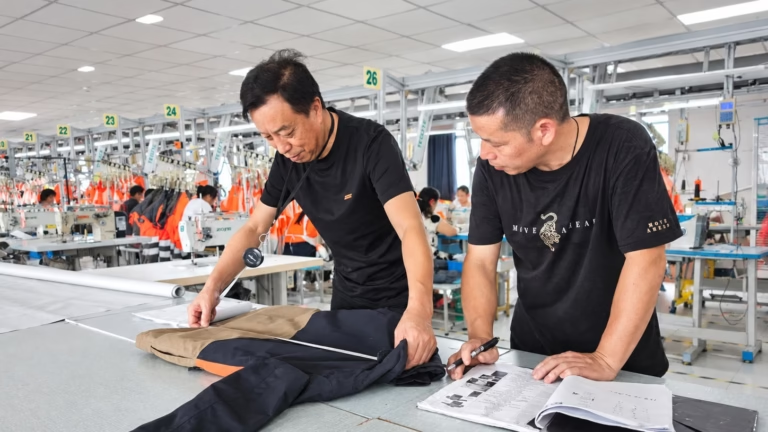
Varytex also encounters requirements that are clearly documented but become questionable during actual development. A measurement or workmanship instruction may be too theoretical for practical production. Pattern making or grading can expose a problem that was not obvious in the original information. A design may also look workable in a drawing but prove difficult to manufacture as specified or create an unintended functional issue.
When this happens, we normally explain the problem, propose a recommendation or possible solution, and ask the buyer to confirm the direction where a buyer decision is required.
There is still room for factory judgment. Some minor unspecified dimensions or non-visible implementation details may be handled through manufacturing experience. But if the issue affects an important function, appearance or another requirement the buyer needs to control, it should be discussed rather than silently treated as a factory decision.
A Functional Description May Still Be Too Broad for the Next Material Decision
One multi-season workwear project provides a useful example.
The buyer initially sent style drawings and a description of the required material functions. A reference fabric and more detailed parameter sheet came later.
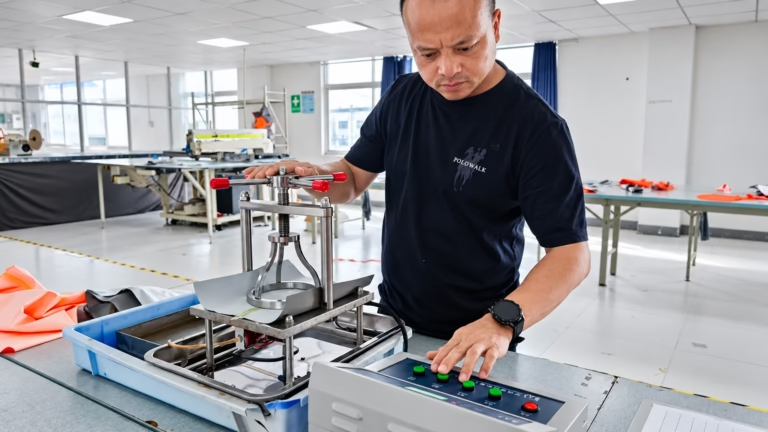
Once Varytex reviewed the reference fabric and parameter sheet in detail, it became clear that a similar functional direction did not mean every technical parameter would be the same.
Some requested parameters could not be achieved exactly as specified. We explained what could be achieved and where the differences were. For some points, the buyer accepted the achievable level. For others, we changed the material to meet the selected parameter requirements without changing the intended appearance.
The original functional description had been useful, it established a direction. But it had not yet defined everything needed for the material decision.
Clarification Does Not Always Mean the Quotation Must Change
A clarification affects the quotation when it changes the basis behind the quotation.
In Varytex’s experience, changes to materials, major dimensions or significant panel and styling construction can affect cost. Other adjustments, such as some minor dimensional changes, some changes to packaging method or changes among conventional colors, may leave the original cost basis unchanged in a particular project.
These are not universal pricing rules. The commercial effect depends on what the change actually alters.
The Better Question Is Not “Is the RFQ Complete?”
Trying to finalize every possible detail before quotation is not always necessary. What matters is knowing which requirements are already confirmed, which are still being handled on a provisional basis, and which decisions still need to come from the buyer.
The manufacturer also needs to understand what an open requirement affects. If changing it later would change the material, construction, performance target or commercial basis, it deserves more attention than a detail that can safely remain provisional at that stage.
And completeness on paper is not enough by itself. Manufacturing review can still reveal that a documented requirement is impractical or does not define the intended result clearly enough.
For an early functional apparel project, the useful target is therefore not maximum documentation as soon as possible. It is enough clarity for the decisions that need to be made now, while keeping unresolved requirements visible for later confirmation.
Develop Functional Apparel with Varytex
See how Varytex supports requirement clarification, material and construction decisions, sampling and functional apparel product development for OEM and ODM projects.